

In the high-altitude apple orchards of Himachal Pradesh, the mid-monsoon months of July and August consistently bring a severe agricultural crisis: widespread premature defoliation, particularly across popular cultivars like Red Delicious. Historically, orchard management has treated this early leaf drop purely as a phytopathological outbreak, placing sole blame on opportunistic fungal pathogens such as Alternaria Leaf Blotch (Alternaria alternata f. sp. mali) and Marssonina Leaf Blotch.
However, modern plant physiology reveals that these aggressive fungal infections are rarely the primary cause. Instead, they are secondary symptoms of an invisible internal breakdown: severe carbohydrate starvation at the root level, which dismantles the tree’s root-derived hormonal immunity and leaves the canopy completely defenseless.
1. Fruit Fill Sink Demand & Root Starvation
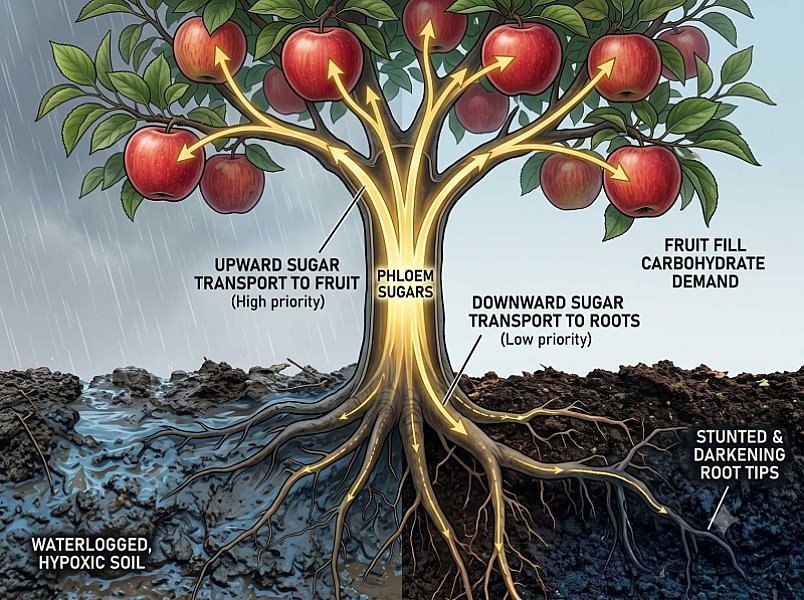
The root of this systemic crisis lies in the intense physiological competition between growing fruit and the rest of the tree. During the rapid fruit-fill stage in July and August, developing apple seeds synthesize high concentrations of auxins. This localized surge of auxins transforms the growing fruit into the dominant "carbohydrate sink" within the tree’s vascular network.
As fruit development accelerates, crop load demands consume up to 80% of currently synthesized photosynthates (Wünsche & Lakso, 2000). Because sugars are preferentially funneled upward to maximize fruit size and energy needs, carbon allocation down to the lower canopy and underground root architecture drops precipitously (Bangerth, 1989).
This carbohydrate shortage coincides with the peak of the Himalayan monsoon, when heavy rainfall creates waterlogged, oxygen-depleted (hypoxic) soil conditions. Starved of essential sugars and deprived of soil oxygen, active root tips experience a sudden arrest in cellular respiration and elongation, effectively stalling root system vitality right when crop demand is at its absolute peak.
2. Cytokinin Collapse & Premature Leaf Senescence
Under normal conditions, active root apical meristems serve as the primary manufacturing hubs for cytokinins—the essential plant hormones that sustain chlorophyll levels, stimulate cell division, maintain structural integrity, and delay leaf aging (Aloni et al., 2006).
When carbohydrate starvation halts root tip growth, the synthesis and upward translocation of root-derived cytokinins through the xylem abruptly collapse. As foliar cytokinin levels fall, the tree upregulates specific cytokinin-degrading enzymes, such as MdCKX7 in apple tissues, which accelerates functional leaf senescence, causes rapid chlorosis (yellowing), and initiates structural tissue degradation (Zhang et al., 2025).
3. Secondary Pathogen Exploitation & Environmental Stress Factors
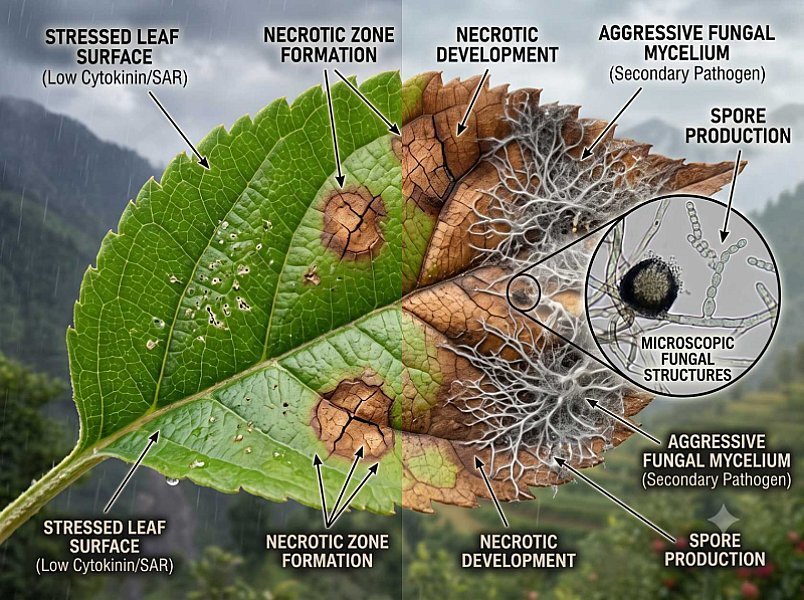
Modern field and physiological research confirms that opportunistic fungi like Alternaria spp. and Marssonina coronaria are not primary plant invaders on healthy foliage. Instead, recent studies demonstrate that Alternaria acts predominantly as a secondary colonizer, taking advantage of pre-existing tissue injury, physiological stress, or metabolic breakdown rather than initiating damage independently (Prechsl et al., 2023; Cabrefiga et al., 2022).
The onset of explosive late-summer defoliation flushes—which consistently align with peak fruit fill—is triggered when underlying physiological, environmental, and pest stresses collapse the leaf's structural defenses:
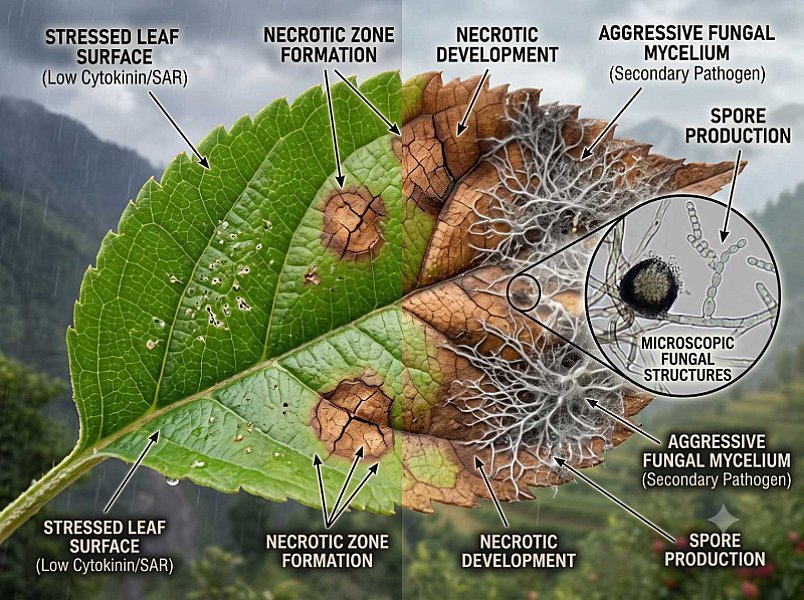
Necrotic Leaf Blotch (NLB): NLB is an established physiological disorder tied directly to severe hormonal disruptions and metabolic stress during warm, humid monsoon periods. The resulting sudden necrotic patches create primary dead tissue zones that secondary fungal pathogens immediately exploit.
Mite Feeding & Micro-Wounding: Foliar feeding by pests such as the European Red Mite (Panonychus ulmi) punctures leaf epidermal cells. These physical micro-lesions serve as direct entry points, elevating fungal infection rates on damaged leaves compared to intact foliage.
Chemical Phototoxicity: Under high temperatures and saturated humidity, aggressive summer spray applications (or chemical burn from improper tank mixes) cause chemical phototoxicity. This localized tissue damage generates dead leaf spots where saprophytic and opportunistic fungal spores rapidly germinate.
As root-derived cytokinin levels drop and the canopy's innate Systemic Acquired Resistance (SAR) weakens, these combined stress factors (NLB, mite injury, and phototoxicity) breach the leaf's cellular barrier. Secondary fungal pathogens then rapidly colonize the already-damaged host tissues, accelerating necrotic lesion expansion and driving widespread premature leaf drop across the orchard.
4. Biological Interventions & Induced Systemic Resistance
To counteract root starvation and preserve internal hormonal balance, biological soil management provides a direct alternative to over-relying on synthetic chemical fungicides.
Introducing Plant Growth-Promoting Rhizobacteria (PGPRs)—particularly high-performing strains of Bacillus and Pseudomonas—into the rhizosphere helps sustain root system health even under severe environmental stress (Lugtenberg & Kamilova, 2009). These beneficial microbes synthesize exogenous cytokinins directly around the root zone, compensating for the tree's internal hormonal drop. Concurrently, PGPR colonizers trigger Induced Systemic Resistance (ISR) throughout the vascular system, reinforcing leaf structural integrity and strengthening natural defense mechanisms against opportunistic fungal attack (Pieterse et al., 2014).
Regenerative Management Strategies
Preventing premature leaf fall and summer disease flushes requires shifting away from reactive fungicide sprays toward actively maintaining root-system dominance (cytokinin dominance) throughout the fruit-fill period. Because cytokinins are synthesized in actively expanding root tips every 24 hours, any stall in root growth causes cytokinin levels to collapse, driving an auxin-dominant state that dismantles natural foliar defenses and leaves leaves vulnerable to secondary infections.
1. Apply Foliar "Synergistic Stacks" During Fruit Fill
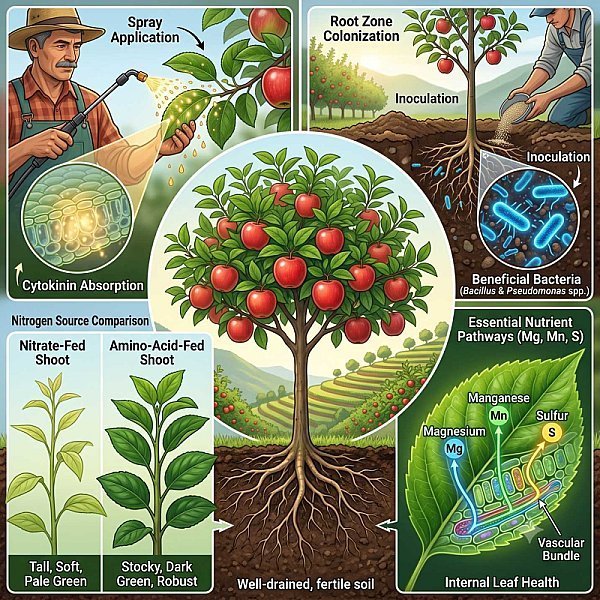
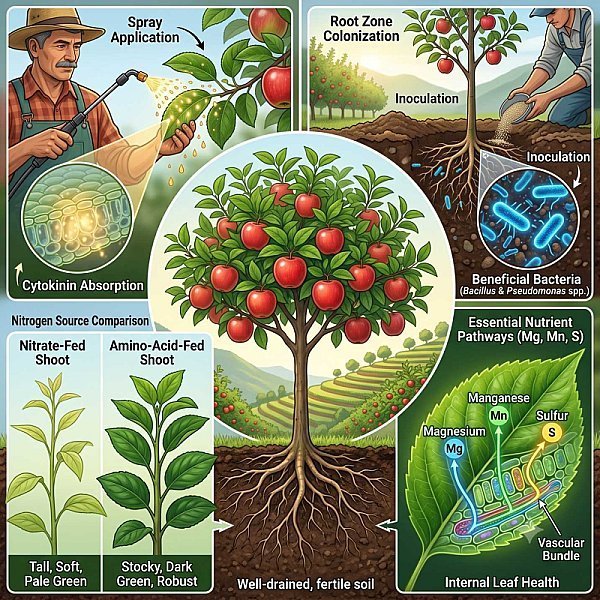
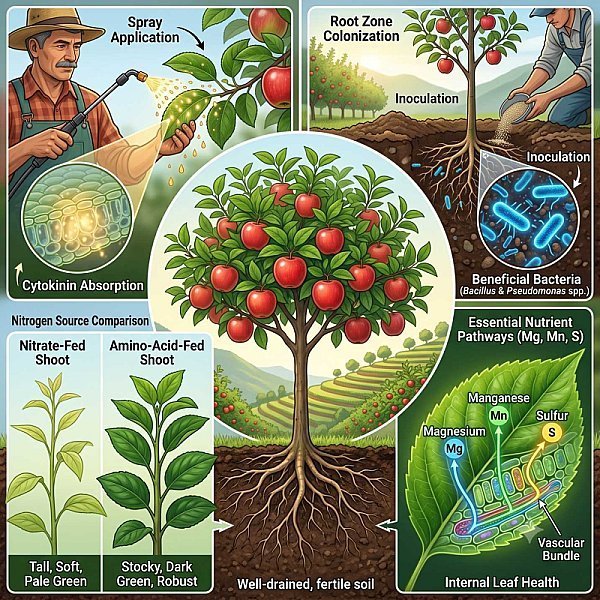
Applying standalone synthetic hormones often yields inconsistent results because the plant lacks the specific nutrient co-factors required to process them. Instead, orchardists should apply synergistic foliar stacks during critical reproductive stages—particularly peak fruit fill.
High-Cytokinin Kelp/Seaweed Extracts: Serves as the foundational biostimulant to replenish foliar cytokinin levels directly.
Synergistic Co-Factor Minerals: Combine seaweed extracts with calcium, cobalt, manganese, and molybdenum. Calcium and cobalt provide the exact nutritional co-factors needed for the plant to utilize cytokinins efficiently while suppressing ethylene-driven leaf senescence.
2. Rhizosphere Inoculation with Plant Growth-Promoting Rhizobacteria (PGPR)
To ensure continuous hormone synthesis even when heavy crop loads reduce carbon allocation to the roots, apply high-performing PGPR strains (such as Bacillus and Pseudomonas) to the root zone multiple times throughout the season (Lugtenberg & Kamilova, 2009). These beneficial rhizobacteria actively synthesize exogenous cytokinins directly within the soil matrix, feeding them into the vascular stream and maintaining root-system dominance even under oxygen-depleted monsoon soil conditions (Pieterse et al., 2014).
3. Precision Nitrogen Management (Eliminating Nitrate Absorption)
The form of nitrogen supplied to the orchard strongly dictates hormonal balance and overall disease susceptibility:
Avoid Nitrate-Nitrogen ($NO_3^-$) and Excessive Potassium ($K$): Nitrate-N, excess potassium, and high chlorides actively drive auxin dominance, spurring rapid, soft vegetative shoot growth that starves root systems and weakens cellular walls.
Shift to Amino Acid & Organic Microbial Nitrogen: Prioritize nitrogen inputs delivered as amino acids and microbial metabolites. Plants nourished via organic amino acid pathways maintain balanced carbon-to-nitrogen ratios, lower internal metabolic stress, and sustain root tip respiration throughout heavy monsoon rains.
4. Target Targeted Nutrients (Mg, Mn, S) to Prevent Physiological NLB
Because Necrotic Leaf Blotch (NLB) and physiological chlorosis create the initial dead tissue zones that secondary invaders like Alternaria colonize (Prechsl et al., 2023; Cabrefiga et al., 2022), controlling physiological leaf degradation is essential. Orchardists should apply targeted sprays of Magnesium (Mg), Manganese (Mn), and Sulfur (S) prior to and during monsoon conditions:
Magnesium & Sulfur: Maintain chlorophyll production and carbon transport under overcast monsoon skies, preventing the sudden physiological collapse of leaf tissue.
Manganese: Drives fundamental enzyme activations that protect cellular structures from oxidative stress, shutting down the primary physiological triggers of NLB before opportunistic fungal spores can take hold.



Comments
No comments yet. Be the first to share your thoughts!