Across major apple-growing regions, growers are locked in a high-stakes rat race: chasing whichever scion variety or new strain fetched the top price per box at last season's auction. We celebrate record crate prices and market spikes, but we rarely calculate the hidden ledger—the actual cost of production.
Fetching a premium market rate means nothing if expensive chemical sprays, heavy ladder labor, and dying trees wipe out your profits. The ultimate metric of a successful farm isn't gross turnover; it is net savings retained in your bank account after subtracting every input expense.
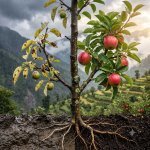
To build an orchard that remains financially solid for the next 20 years, growers must look past top-coat variety trends and focus on the engine beneath the surface: the rootstock.
1. The Financial Reality: Gross Sales vs. Net Savings
Chasing new varieties or strain conversions without changing the underlying root system often creates a financial trap:
The Chemical Burden: Forcing unadapted or weak root systems to yield "market quality" fruit leads to an escalating spray program—growth regulators, chemical thinners, color enhancers, and intensive pesticide schedules.
Labor Overhead: Labor routinely accounts for 50% to 60% of annual operating expenses in traditional orchards. Giant, ladder-dependent seedling canopies require massive labor hours for winter pruning, hand-thinning, and harvesting.
The Margin Squeeze: A farmer selling fruits for 20,00,000.00 rs with ₹ 13,00,000.00 in input and labor expenses nets saving is 7,00,000.00. A farmer using low-input, highly efficient systems selling ₹15,00,000 with 5,00,000 in expenses nets saving ₹10,00,000 —a higher net return on a lower-priced fruit.

2. Soil Burnout and the Biological Trap
Many growing belts still rely on traditional seedling roots or susceptible rootstocks that lack defense against modern soil pathogens. When orchards face collar rot (Phytophthora), Fire Blight, Woolly Apple Aphid, or Apple Replant Disease (ARD), the typical reaction is to pour chemical drenches, fungicides, and bactericides into the soil floor. This happens a lot with M or MM series rootstocks.
The Biological Paradox: Chemical drenches attempt to suppress root rot and replant pathogens, but they sterilize beneficial soil microbes and mycorrhizal networks in the process. This weakens root vitality further, creating an ongoing cycle of rising chemical expenses and declining tree health.
3. By the Numbers: Traditional Seedling vs. Modern Resistant Rootstocks
Investing in modern, resistant dwarfing or semi-dwarfing rootstocks (such as targeted Geneva® series or size-controlling clones) shifts your farm architecture from chemical dependency to built-in genetic resilience.
Hard Performance Metrics:
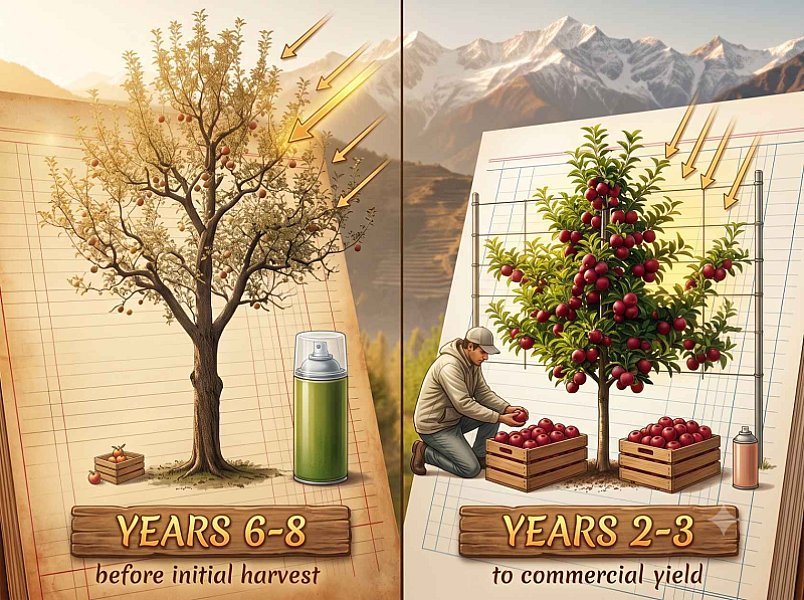
Yield Precocity (Speed to Returns): Traditional seedling rootstocks delay commercial production until Years 6 to 8. Modern dwarfing rootstocks (e.g., G.41, G.969, G.935, G214) produce commercial yields by Years 2 to 3, allowing growers to service establishment debts years faster.
Production Capacity: Mature seedling orchards produce approximately 4 to 5 Metric Tonnes (MT) per acre. High-density modern rootstock systems produce 12 to 14+ MT per acre due to superior light interception and uniform canopy space.
Chemical Application Efficiency: Narrow, 2D "pedestrian" canopies on dwarfing rootstocks reduce spray drift and chemical application volumes by 30% to 50% per acre compared to dense, 15-to-20-foot 3D seedling canopies.
Genetic Pathogen Defense: Resistant rootstocks (like G.41, G.210, G.890) carry genetic resistance to Fire Blight, Crown Rot, and Replant Disease built into their DNA. This eliminates the need for expensive soil fumigants, chemical drenches, and emergency sprays.
Labor Productivity: Pruning, thinning, and harvesting from the ground without heavy ladders increases worker harvesting efficiency by 40% to 60%, drastically cutting seasonal payroll costs.
4. Tree Replacement and Risk Management
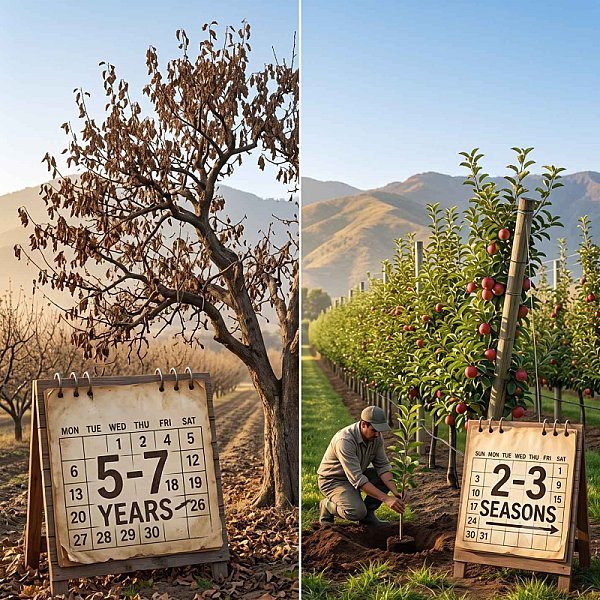
When a 20-foot traditional seedling tree dies from root rot or fire blight, it leaves a massive gap in your canopy, taking 5 to 7 years of regrowth to restore lost volume.
In contrast, replacing a small dwarfing tree on a trellis system is straightforward, low-cost, and returns to full bearing capacity within 2 to 3 seasons—protecting your orchard's overall baseline yield from devastating dips.
The Bottom Line
A trendy scion variety or new strain might offer a short-term marketing spike, but the right rootstock secures your net profits for 20 years.
Stop evaluating your orchard's success by top-line auction prices alone. Choose rootstocks that eliminate subterranean disease, slash labor and chemical costs, and maximize what truly matters: the profit you keep at the end of every harvest.
प्रमुख सेब उत्पादक क्षेत्रों में, किसान एक हाई-स्टेक्स रैट रेस में फंसे हुए हैं: पिछले सीज़न की ऑक्शन में जिस सायन वैरायटी या नए स्ट्रेन ने प्रति बॉक्स सबसे ऊँचा दाम लिया, उसी का पीछा करना। हम रिकॉर्ड क्रेट प्राइसेज़ और मार्केट स्पाइक्स का जश्न मनाते हैं, लेकिन शायद ही कभी हिडन लेजर—प्रोडक्शन की असली कॉस्ट—की गणना करते हैं।
प्रीमियम मार्केट रेट हासिल करने का कोई मतलब नहीं है अगर महंगे केमिकल स्प्रेज़, भारी सीढ़ी लेबर, और मरते पेड़ आपके प्रॉफिट को खा जाएँ। एक सफल फार्म का अल्टीमेट मैट्रिक ग्रॉस टर्नओवर नहीं है; यह हर इनपुट खर्च घटाने के बाद आपके बैंक अकाउंट में रहने वाला नेट सेविंग्स है।
अगले 20 सालों तक फाइनेंशियल रूप से मजबूत बाग बनाने के लिए, किसानों को टॉप-कोट वैरायटी ट्रेंड्स से आगे देखना होगा और सरफेस के नीचे के इंजन पर फोकस करना होगा: रूटस्टॉक।
1. फाइनेंशियल रियलिटी: ग्रॉस सेल्स बनाम नेट सेविंग्स
अंडरलाइंग रूट सिस्टम बदले बिना नई वैरायटीज़ या स्ट्रेन कन्वर्ज़न का पीछा करना अक्सर एक फाइनेंशियल ट्रैप बनाता है:
केमिकल बर्डन: कमज़ोर या अनअडैप्टेड रूट सिस्टम से 'मार्केट क्वालिटी' फल पैदा करने के लिए बढ़ता हुआ स्प्रे प्रोग्राम चलाना पड़ता है—ग्रोथ रेगुलेटर्स, केमिकल थिनर्स, कलर एनहांसर्स, और इंटेंसिव पेस्टिसाइड शेड्यूल्स।
लेबर ओवरहेड: पारंपरिक बागों में लेबर नियमित रूप से सालाना ऑपरेटिंग खर्च का 50% से 60% होता है। विशाल, सीढ़ी-निर्भर सीडलिंग कैनोपीज़ को विंटर प्रूनिंग, हैंड-थिनिंग, और हार्वेस्टिंग के लिए बहुत ज़्यादा लेबर घंटों की ज़रूरत होती है।
मार्जिन स्क्वीज़: जो किसान 20,00,000.00 रुपये में फल बेचता है, और जिसका इनपुट और लेबर खर्च ₹ 13,00,000.00 है, उसकी नेट सेविंग्स 7,00,000.00 होती है। वहीं जो किसान लो-इनपुट, हाई-एफिशिएंट सिस्टम इस्तेमाल करके ₹15,00,000 में बेचता है और जिसका खर्च 5,00,000 है, उसकी नेट सेविंग्स ₹10,00,000 होती है—कम दाम वाले फल पर ज़्यादा नेट रिटर्न।

2. सॉइल बर्नआउट और बायोलॉजिकल ट्रैप
कई ग्रोइंग बेल्ट्स आज भी पारंपरिक सीडलिंग रूट्स या ऐसे सस्पेटिबल रूटस्टॉक्स पर निर्भर हैं जिनमें मॉडर्न सॉइल पैथोजेन्स के खिलाफ डिफेंस की कमी है। जब बागों में कॉलर रॉट (Phytophthora), फायर ब्लाइट, वूली एप्पल एफिड, या एप्पल रीप्लांट डिज़ीज़ (ARD) आती है, तो आम रिएक्शन मिट्टी में केमिकल ड्रेंच, फंगिसाइड्स, और बैक्टीरिसाइड्स डालने का होता है। M या MM सीरीज़ रूटस्टॉक्स के साथ यह बहुत होता है।
बायोलॉजिकल पैराडॉक्स: केमिकल ड्रेंचेज़ रूट रॉट और रीप्लांट पैथोजेन्स को सप्रेस करने की कोशिश करते हैं, लेकिन प्रोसेस में बेनिफिशियल सॉइल माइक्रोब्स और माइकोराइज़ल नेटवर्क्स को स्टरलाइज़ कर देते हैं। यह रूट विटैलिटी को और कमज़ोर करता है, जिससे बढ़ते केमिकल खर्च और घटती पेड़ सेहत का चक्र चलता रहता है।
3. आँकड़ों में: पारंपरिक सीडलिंग बनाम मॉडर्न रेज़िस्टेंट रूटस्टॉक्स
मॉडर्न, रेज़िस्टेंट ड्वार्फिंग या सेमी-ड्वार्फिंग रूटस्टॉक्स (जैसे टार्गेटेड Geneva® सीरीज़ या साइज़-कंट्रोलिंग क्लोन्स) में निवेश आपकी फार्म आर्किटेक्चर को केमिकल डिपेंडेंसी से बिल्ट-इन जेनेटिक रेज़िलिएंस में शिफ्ट कर देता है।
हार्ड परफॉर्मेंस मेट्रिक्स:
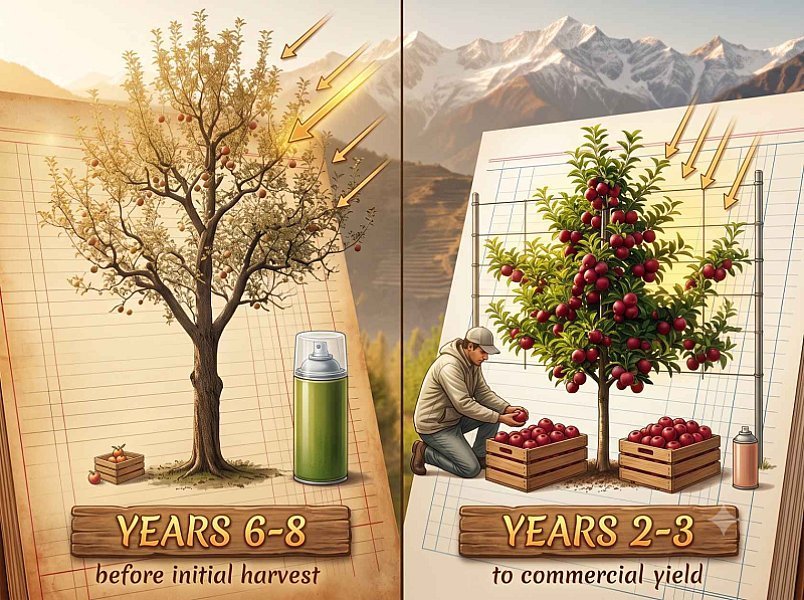
यील्ड प्रीकोसिटी (रिटर्न्स की स्पीड): पारंपरिक सीडलिंग रूटस्टॉक्स कमर्शियल प्रोडक्शन को साल 6 से 8 तक डिले करते हैं। मॉडर्न ड्वार्फिंग रूटस्टॉक्स (जैसे G.41, G.969, G.935, G214) साल 2 से 3 तक कमर्शियल यील्ड देते हैं, जिससे किसान एस्टैब्लिशमेंट कर्ज़ सालों पहले चुका सकते हैं।
प्रोडक्शन कैपेसिटी: मैच्योर सीडलिंग ऑर्चर्ड प्रति एकड़ लगभग 4 से 5 मेट्रिक टन (MT) उत्पादन करते हैं। हाई-डेंसिटी मॉडर्न रूटस्टॉक सिस्टम बेहतर लाइट इंटरसेप्शन और यूनिफॉर्म कैनोपी स्पेस की वजह से प्रति एकड़ 12 से 14+ MT उत्पादन करते हैं।
केमिकल एप्लिकेशन एफिशिएंसी: ड्वार्फिंग रूटस्टॉक्स पर नैरो, 2D 'पेडेस्ट्रियन' कैनोपीज़ घनी, 15-से-20-फुट 3D सीडलिंग कैनोपीज़ की तुलना में प्रति एकड़ स्प्रे ड्रिफ्ट और केमिकल एप्लिकेशन वॉल्यूम को 30% से 50% तक कम करती हैं।
जेनेटिक पैथोजन डिफेंस: रेज़िस्टेंट रूटस्टॉक्स (जैसे G.41, G.210, G.890) अपने DNA में फायर ब्लाइट, क्राउन रॉट, और रीप्लांट डिज़ीज़ के खिलाफ जेनेटिक रेज़िस्टेंस रखते हैं। यह महंगे सॉइल फ्यूमिगेंट्स, केमिकल ड्रेंचेज़, और इमर्जेंसी स्प्रेज़ की ज़रूरत खत्म कर देता है।
लेबर प्रोडक्टिविटी: भारी सीढ़ियों के बिना ज़मीन से प्रूनिंग, थिनिंग, और हार्वेस्टिंग करने से वर्कर हार्वेस्टिंग एफिशिएंसी 40% से 60% तक बढ़ जाती है, जिससे सीज़नल पेरोल खर्च नाटकीय रूप से घटता है।
4. पेड़ बदलना और रिस्क मैनेजमेंट
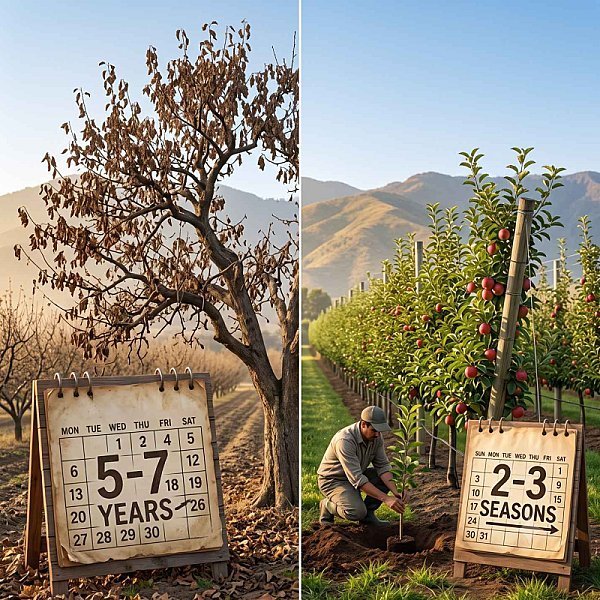
जब रूट रॉट या फायर ब्लाइट से 20-फुट का पारंपरिक सीडलिंग पेड़ मर जाता है, तो यह आपकी कैनोपी में बड़ा गैप छोड़ता है, और खोई हुई वॉल्यूम बहाल करने में 5 से 7 साल की रीग्रोथ लगती है।
इसके उलट, ट्रेलिस सिस्टम पर छोटे ड्वार्फिंग पेड़ को बदलना आसान, कम खर्च वाला होता है, और 2 से 3 सीज़न के भीतर पूरी बियरिंग कैपेसिटी पर लौट आता है—जिससे आपके ऑर्चर्ड की बेसलाइन यील्ड विनाशकारी गिरावट से सुरक्षित रहती है।
द बॉटम लाइन
एक ट्रेंडी सायन वैरायटी या नया स्ट्रेन शॉर्ट-टर्म मार्केटिंग स्पाइक दे सकता है, लेकिन सही रूटस्टॉक 20 साल तक आपके नेट प्रॉफिट्स को सुरक्षित रखता है।
अपने ऑर्चर्ड की सफलता को सिर्फ टॉप-लाइन ऑक्शन प्राइसेज़ से आँकना बंद करें। ऐसे रूटस्टॉक्स चुनें जो अंडरग्राउंड डिज़ीज़ को खत्म करें, लेबर और केमिकल खर्च घटाएँ, और उस चीज़ को मैक्सिमाइज़ करें जो सच में मायने रखती है: हर हार्वेस्ट के अंत में आपके पास बचा प्रॉफिट।




Comments
No comments yet. Be the first to share your thoughts!