
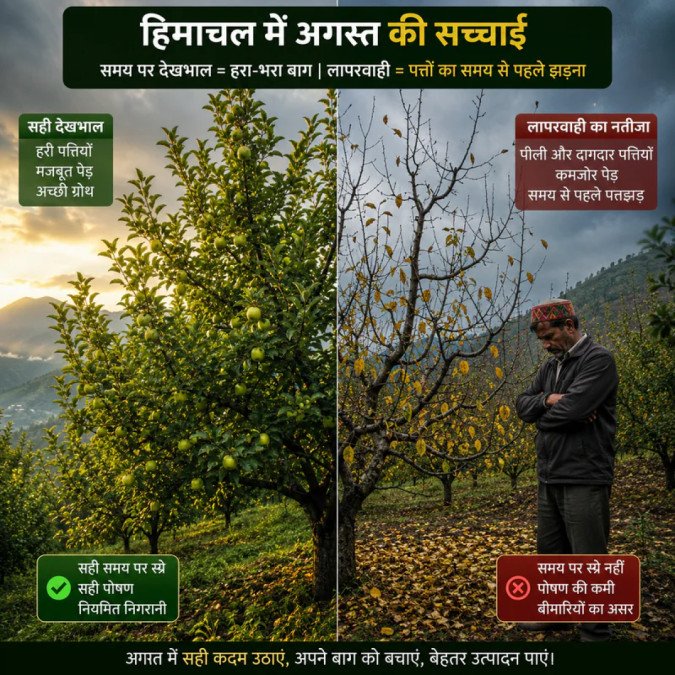
Every monsoon, the same tragedy plays out across the apple belts of Himachal Pradesh. From Shimla to Kinnaur, lush green canopies suddenly turn yellow, break out in black spots, and drop to the ground. By late August, right when the fruit needs the maximum energy to pull color and size, our trees look like it's mid-December.
We call it "Early Leaf Fall" or blame it entirely on Alternaria and Marssonina.
And what do we do? We panic. We run to the pesticide dealer. We blast our orchards with systemic fungicides, mixing toxic cocktails that cost a fortune, destroy our soil biology, and leave chemical residues on our fruit.
But here is the hard, frustrating truth: The entire system is completely blind to what is actually happening.
The Horticulture Department doesn't get it. The universities keep churning out the same outdated chemical spray schedules year after year. The fruit grower societies are stuck in the loop of demanding pesticide subsidies. Even the self-proclaimed " influencer farmers" on Facebook and WhatsApp groups are just arguing over which expensive chemical brand works better.
Nobody is asking the real question: Why are the leaves weak enough to fall in the first place?
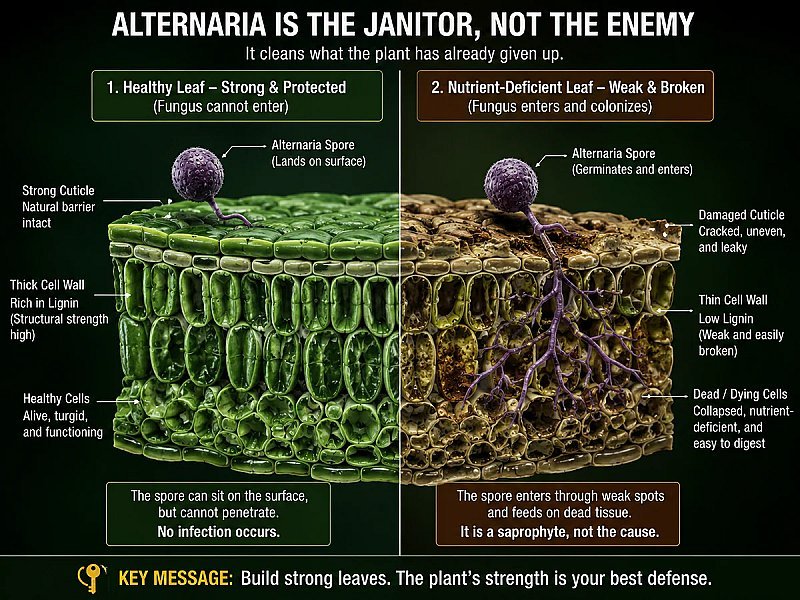
Alternaria Is Not the Enemy—It's the Janitor
We have been conditioned to think of fungal spores as aggressive invaders that attack healthy trees. It's a lie.
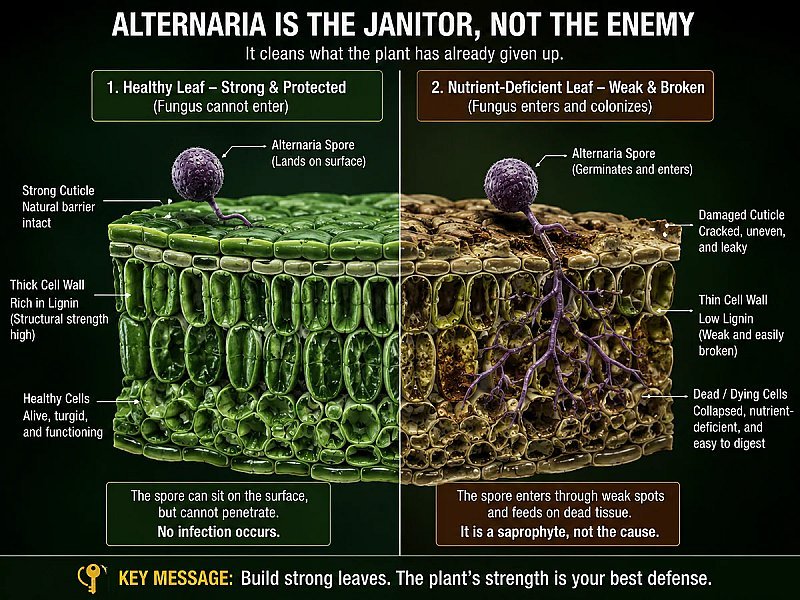
Peer-reviewed international research—including a massive landmark study published in Scientific Reports—has fundamentally proven that Alternaria is a weak, secondary colonizer. It cannot infect a structurally sound, nutritionally complete apple leaf.
What actually happens is that your tree runs out of essential micronutrients—specifically Manganese (Mn) Magnesium (Mg) and Sulphur (s) —during the heavy stress of the summer crop load and monsoon rains. When these levels drop, the leaf experiences microscopic physiological cell death.
The leaf breaks down internally first. Only then does the Alternaria spore land on that dead tissue and start eating it. The fungus didn't kill the leaf; it just showed up to clean up the tissue that was already dying from starvation.
The Root Cause: Leaf Necrosis and Mite Damage Are the Real Open Doors
To understand exactly why Alternaria gets a foothold, we have to look at what scientists call primary damage. Science proves that the fungus requires a pre-existing "open wound" or dead zone to enter the leaf. In our orchards, this open door is created by two things: Abiotic Leaf Necrosis and Mite Damage.
Physiological Leaf Necrosis (Internal Starvation)
Before any fungus arrives, the leaf breaks down from the inside out due to nutrient starvation. During droughts and temperature variations there is a hormonal imbalance which further leads to nutrition deficiency and the trees suffer from a severe deficiency of Magnesium and Manganese, the cellular machinery inside the leaf begins to fail.
Magnesium is the central core of chlorophyll (what makes the leaf green and processes sunlight). When it runs low, the cell's energy factory shuts down. Manganese deficiency stalls the plant's internal defense pathways, leaving cell walls thin and fragile.
This internal starvation causes abiotic physiological leaf blotch—a non-parasitic disorder where sections of the leaf tissue naturally die and turn into dry, brown, dead spots (necrosis).
What the Research Says
In controlled laboratory tests, scientists took completely healthy, intact apple leaves and coated them with heavy loads of Alternaria spores. The result? No disease developed. The fungus could not breach a healthy leaf cell wall.
However, when researchers introduced leaves that had physiological necrosis (nutrient blind spots) or some phytotoxicity due to chemicals, the Alternaria instantly colonized the damaged areas. The studies explicitly conclude that Alternaria is an opportunistic saprophyte—a fungus that feeds on dead or dying organic matter. It relies entirely on the pre-existing cellular breakdown caused by nutrient deficiencies and mite feeding to establish its footprint.
The Blind Spot: The Chemical Spray Loop
When the department recommends blasting the canopy with chemical fungicides, they are just treating the symptom. The fungicide might temporarily burn down the fungal spores, but it does absolutely nothing to fix the underlying cellular weakness of the tree.
Worse yet, heavy chemical use locks up the soil, ensuring the tree can absorb even fewer nutrients next year. It is a profitable loop for chemical companies, but a losing battle for the Indian apple farmer.
What the Research Says
In controlled laboratory tests, scientists took completely healthy, intact apple leaves and coated them with heavy loads of Alternaria spores. The result? No disease developed. The fungus could not breach a healthy leaf cell wall.
However, when researchers introduced leaves that had physiological necrosis (nutrient blind spots) or microscopic mite punctures, the Alternaria instantly colonized the damaged areas. In Alternaria-associated apple leaf blotch, the evidence suggests that Alternaria often behaves as a secondary colonizer of physiologically weakened tissue —a fungus that feeds on dead or dying organic matter. It relies entirely on the pre-existing cellular breakdown caused by nutrient deficiencies and mite feeding to establish its footprint.
The Blind Spot: The Chemical Spray Loop
When the department recommends blasting the canopy with chemical fungicides, they are just treating the symptom. The fungicide might temporarily burn down the fungal spores, but it does absolutely nothing to fix the underlying cellular weakness of the tree.
Worse yet, Repeated dependence on fungicides does not correct the nutritional or physiological factors that predispose leaves to disease, and some fungicides may negatively affect beneficial microbial communities. l, ensuring the tree can absorb even fewer nutrients next year. It is a profitable loop for chemical companies, but a losing battle for the Himachali farmer.
The Real Solution: Exactly How the Scientists Stopped It
If you want to stop early leaf fall, you don't need a stronger poison. You need to give the tree the exact elements it is starving for.
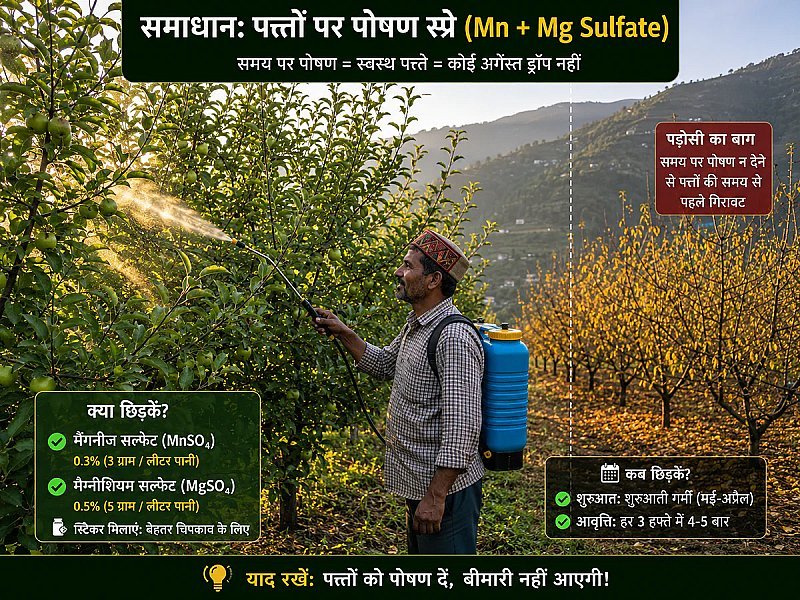
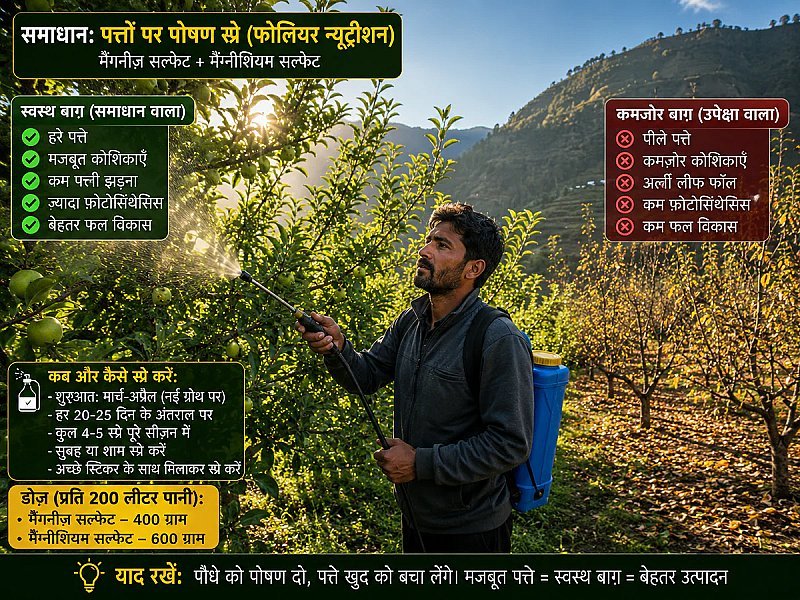
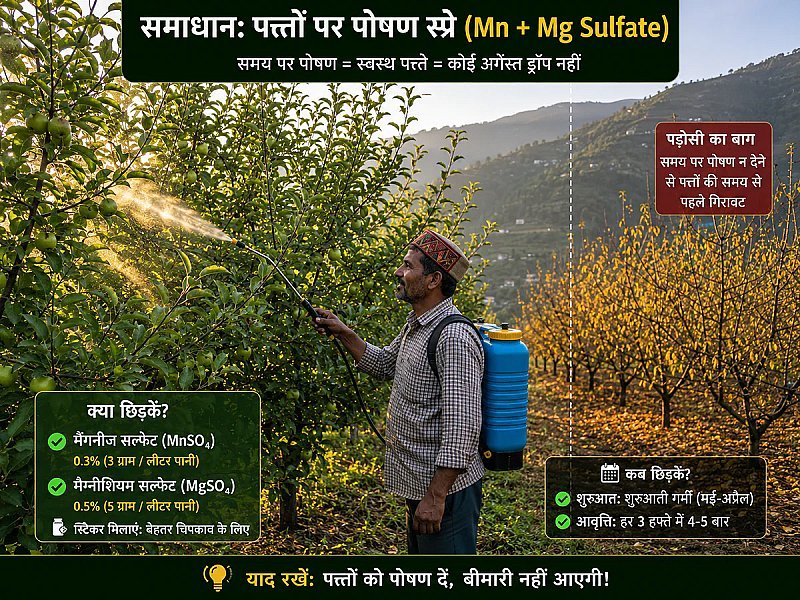
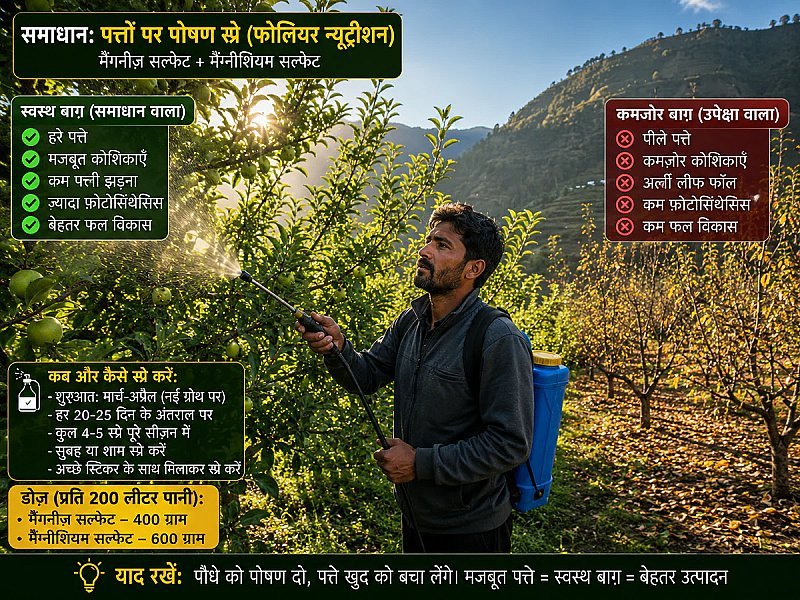
In the field trials, the researchers didn't use secret, complex chemical molecules. They simply applied a liquid foliar spray containing standard Manganese Sulfate and Magnesium Sulfate directly to the tree canopy.
They sprayed the leaves 4 to 5 times over the season, starting in early summer and repeating every three weeks. By doing nothing more than delivering raw manganese and magnesium directly to the leaves, they achieved nearly double the disease control of 8 to 11 standard commercial fungicide sprays.
Bringing in the Regenerative View
While the scientific study proves that simple sulfates work beautifully to fix the leaf and stop the fungus, regenerative farming allows us to refine this method even further. In a biological system, we can mix these essential sulfates with organic acids (like fulvic acid, humic acid, or citric acid) or amino acids.
Adding these natural organic compounds complexes the minerals, making them mimic nature. The organic acids act as a natural buffer that reduces salt stress and improves compatibility with biological programs, reduces the salt shock to the leaf cuticle, and allows the tree to absorb the Manganese and Magnesium much more efficiently. It takes the exact mechanism proven by the scientists and makes it safer and more energetic for the tree.
How It Works Inside the Leaf
When you deliver bioavailable Manganese directly to the leaf canopy before the monsoon crunch, you trigger two critical defense mechanisms:
The Lignin Shield: Adequate manganese supports enzymes involved in lignin biosynthesis and other defense pathways. For the plant's internal defense pathway (the shikimic acid pathway). It instantly activates the enzymes responsible for producing lignin and suberin. This builds a thick, physical cell wall that fungal enzymes cannot dissolve.
Fungal Starvation: Manganese halts the enzymes that Alternaria uses to digest plant proteins. Deprived of its "free lunch" sap profile, the spore germinates, finds nothing to eat, and starves to death naturally.
The Definitive Proof: The Petri Dish Experiment That Changed Everything
If you still think nutrition sprays are just a "weak organic alternative" to chemicals, consider how the researchers in that 2023 Scientific Reports study proved their point. They took the exact mineral mix used in the orchards—the blend of magnesium and manganese sulfates—and poured it directly into a Petri dish containing a growing colony of Alternaria fungus. If the mix had any hidden chemical or toxic properties, the fungus would have died. Instead, the Alternaria grew perfectly fine—if anything, it grew slightly better in the dish.
This absolute lack of fungicidal effect proved a groundbreaking concept: The spray did not kill a single fungal spore. Yet, when it was applied to actual apple trees, it reduced Alternaria symptoms across a three-year field trial by a massive 72.7%. The mineral spray didn't fight the fungus; it fundamentally reconfigured the internal physiology of the apple leaves, removing the nutritional deficiencies that cause physiological leaf blotch. By treating the host rather than attacking the pathogen, the researchers demonstrated that structural tree health completely out-performs chemical warfare.
It's Time to Change the Narrative
We cannot keep relying on a system that treats our orchards like patients on permanent chemical life support. The definition of a "progressive farmer" needs to shift from someone who uses the newest chemical molecule to someone who understands plant physiology.
Early leaf fall isn't a fungus problem; it's a management problem. By shifting our focus from killing the pathogen to nourishing the host, we can keep our canopies green, our input costs low, and our orchards thriving—long after the neighbors' trees have stripped bare.
Let's stop poisoning the symptoms. It's time to feed the cure.
Comments 2
But in some of the videos of youtube of yours, you says that mangenese sulphate is not that effective as compare to amino mangenese.
thanks for mentioning that tushar! Thats is absolutly true in other context like regulating potassium or Increasing photosynthesis. In this article i mentioned what they experimented in Italy it worked for them. To control alterneria, mangenese Sulphate did work in that experiment, but for other mangenese roles i am not sure about that. So Amino manganese is important too.